- The LEADx New EQ Newsletter
- Posts
- Your Team Calls EQ A 'Soft Skill.' The Data Shows It's Worth $500K
Your Team Calls EQ A 'Soft Skill.' The Data Shows It's Worth $500K
New data from LEADx on EQ & Salary 📊

Evan Watkins
December 20, 2025
Did someone forward you this newsletter? You can subscribe here.
Want to become a certified EQ coach and facilitator? Learn more here.
When delivering emotional intelligence (EQ) workshops to thousands of L&D professionals over the last year, the same question has come up time and again:
My audience is ___, so they tend to resist or dismiss emotional intelligence as a “soft skill.” How can I show them it matters?
You can fill the blank in with just about any audience. Engineers, air force pilots, law enforcement officers, doctors, executives, and more.
To explore this question in more detail, I ran my own data. Specifically, I looked at 1,499 people to see if their emotional intelligence scores had any bearing on:
Job performance
Salary
The results were impressive. EQ skills were strongly correlated with both job performance and earning power. So much so that a 20% improvement in your EQ score moves you more than halfway toward the next performance tier, and one-third of the way into the next pay tier.
What follows is a detailed breakdown of the findings.
Better EQ, Better Job Performance
For every point by which someone's emotional intelligence score increased, their self-rated job performance ticked up. A 10% increase in EQ roughly translates to a 0.2–0.3 jump on the five-point performance scale. Often, this would be enough to move an employee from “average” to “above average,” or from “above average” to “well above average.”

Increasing your emotional intelligence by just several points is often enough to bump you up another level in job performance.
Higher EQ, Higher Salary
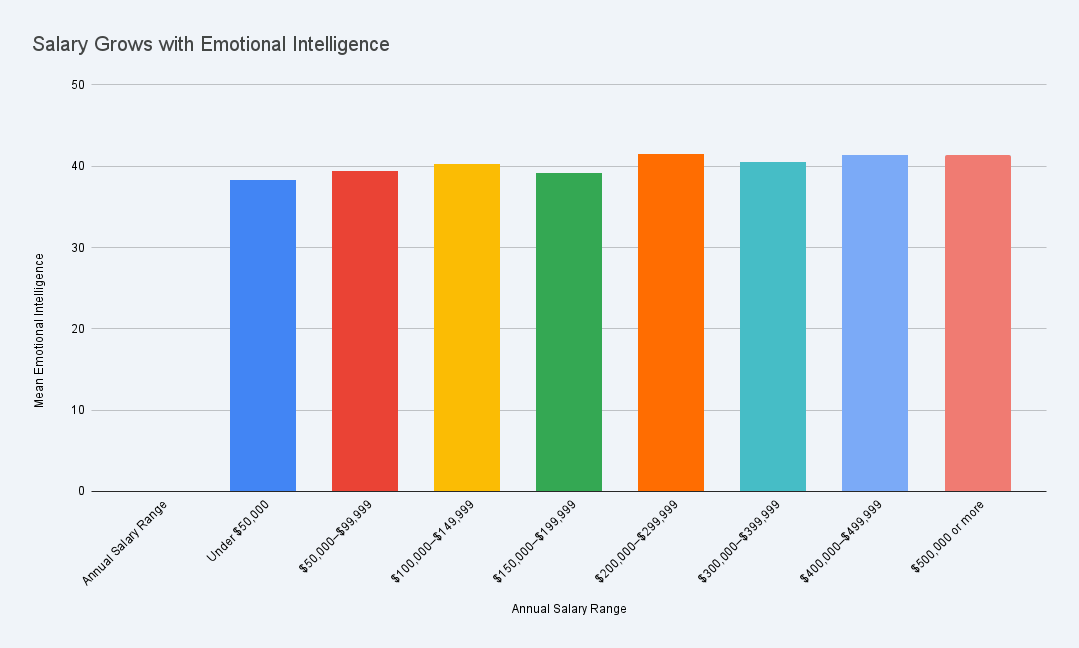
The salary data told a similar story. EQ scores correlated with higher pay tiers. A 10% boost in EQ predicted about a quarter-step increase into the next salary bracket.
Considering that each salary band represents at least a $50,000 jump in salary, even small improvements carry major financial weight. A 20% increase in EQ—which in our dataset equates to around eight additional EQ points—corresponded to roughly $15,000–$20,000 more in annual earnings. Over a 30-year career, that translates to nearly half a million dollars in additional lifetime income.

Though not a perfect staircase, higher EQ scores consistently correlated with higher earnings.
Relationship Management Tops the Charts in Impact on Job Performance and Salary
Emotional intelligence is made up of four core skills: Self-awareness, self-management, social awareness, and relationship management. We found that not only did overall emotional intelligence scores correlate with job performance and salary, but so too did each of the individual core skills.

Emotional intelligence is made up of four core skills: Self-awareness, self-management, social awareness, and relationship management.
When I tested each EQ skill independently, one dimension emerged as consistently the most powerful: Relationship Management. Employees who scored higher in behaviors like resolving conflict, managing feedback, and strengthening workplace relationships were much more likely to report stronger job performance and to fall into higher salary bands. Self-management and social awareness followed closely behind, with self-awareness providing a smaller but still meaningful lift.
This makes sense because to successfully build your relationship management, you need to lean on each of the other core skills. For example, to “give effective feedback” which is a classic relationship management behavior, you need self-awareness to recognize your feelings (i.e., discomfort at delivering a tough-to-hear message), self-management to regulate that emotion (i.e., staying confident and clear despite your discomfort), and social awareness to ensure it’s a good, safe moment to deliver that feedback and to pick up on how your message is being received. All of this together comprises the relationship management behavior of “giving effective feedback.”
Emotional Intelligence is Highly Trainable
Unlike your IQ or your personality, which are relatively fixed and difficult to change, emotional intelligence is a skillset. That means you can improve with deliberate practice.
In his book The New Emotional Intelligence, Travis Bradberry shares a great example of how impactful emotional intelligence training can be. Working with a Fortune 500 company, he trained a group of leaders. Each took an emotional intelligence 360 assessment, then had the option to work one-on-one with a coach, do a series of microlearning exercises, and use a goal-tracking system. Bradberry found that of the leaders who engaged in all three touchpoints, 100% saw improvement in their bottom-line performance. Of those who engaged in two forms of follow-through, 71% saw improvement in their bottom-line performance. And those engaged in no follow-through saw only 18% improvement.
The Five Key Ingredients to Great EQ Training
In his latest book Optimal, Daniel Goleman writes about five ingredients that make for a successful emotional intelligence program. They include:
“Highly motivated participants.” Perhaps my favorite example of this is at MD Anderson Cancer Center, where they make their leadership development program officially count as one year of “people leadership” toward promotability.
“Ten or more hours of training, spaced out over time, with periodic booster sessions.” Of course, more training time is more effective, but think about dosage too. Consider splitting up ten hours into six or more weekly sessions.
“Ongoing practice and reinforcement.” Just like in Bradberry’s example, to improve your emotional intelligence, you need repetition. That means getting your audience to practice enough that new habits stick. Using a 360 assessment can help you measure specific behaviors then hold your leaders accountable for improvement.
“Social support.” One-on-one coaching, group coaching, accountability partners, and creating online forums are all great ways to keep people practicing, interacting, and supporting each other.
“Active modeling and support of key organizational leaders.” The very best organizations all seem to model emotional intelligence from the top. One great example is at Delta Airlines, where the CEO Ed Bastian gives out his email address to every employee.
Next time your audience is slow to invest their energy in emotional intelligence, remind them that the effort pays off (literally!). This is true across both job performance and salary.

Interested in becoming a certified emotional intelligence coach and facilitator? Click to learn more.
Reply